In June quarter 2019, the combined top line of the top five IT services companies -- TCS, Infosys, HCL, Wipro and Tech Mahindra -- stood at Rs 99,800 crore, just Rs 200 crore shy of the Rs 1 lakh crore mark. These companies have hired more than 1M+ people recently. The top companies TCS & Infosys have combined destroyed multiple state ecosystems while creating highly paid zero R&D & zero applied solutions to the IT market. Most of their work has been focused on writing custom solutions that are specified by their clients, which in most cases are big institutional MNCs or National firms that were assigned by their govt to give work to these body shoppers.
TCS has destroyed the R&D infrastructure of Tata companies in Automobile & Iron/Steel by placing govt educated (IIT, NIT, govt engg, Central Univs) post graduates meant for these long term positions into quick money producing body shopper low level Programmer/Tester/Analyst positions all over the world while taking a huge cut of salary for their fake management consisting of few privileged sub-caste members. These directors have demonstrated their fraud capacity by forming profit cartels in collision with vocal minority groups/movements in US and also have formed world wide profit cartels to skim the money out of system.
Likewise, Infosys has formed multiple fake delivery centers in US & research institutes to maintain a highly paid group of managers who are mostly linked to the management as nepotism. These delivery centers are mostly local political stunt to create image of big company among the newly hired junior Programmer/Analysts to work 24/7 using Software downloaded from Internet while the management using most advanced financial methods to skim the system and move the money out to few sub-caste cartels that are spread out in urban ghettos world wide.
In addition these top IT body shoppers are skimming the system by giving back lakhs of Crores of money to their holders in the form of stock buyback. This is like highway robbery of public money given in the form of contracts making their way to the private profit oriented investors. Even though they have huge cash in hand, the R&D efforts of these companies don't go beyond few related directors kin getting into elite western arts universities all within few sub-caste living in their fantasy urban ghettos. In addition these kin have created huge ecosystem at the management level in US & Europe eg. Sundar Pichai etc.. getting 100s of crores per year as salary for just attending board meetings and signing papers.
These highly entitled top managers formed a cartel and exploiting poor people of their sub-castes to make work unnecessary hours to sustain their network. End level employees died by hundreds due to work burnout and social pressures caused by these fraudulent managers playing with government money
Bibilography
https://www.deccanherald.com/business/economy-business/indias-top-5-it-firms-stare-at-historic-revenue-mark-766973.html
https://timesofindia.indiatimes.com/business/india-business/tcs-to-spend-rs-16000-crore-on-share-buyback/articleshow/64608787.cms
Showing posts with label IT. Show all posts
Saturday, October 12, 2019
Thursday, September 28, 2017
IT slowdown & self destructive tendencies
IT slowdown
Indian IT outsourcing was thriving on labor arbitrage, a concept that refers to the shifting of jobs where labor and the cost of doing business is inexpensive due to the reduction or removal of barriers to international trade. However, geopolitical developments across the globe, such as ongoing Brexit concerns, and radical industry shifts to new technologies like cloud computing have sounded out some warning signals to these firms.In a recent presentation to Nasscom, Global advisory firm McKinsey & Company said that nearly half of the workforce in the IT services firms will be “irrelevant” over the next 3-4 years. A similar view was echoed by Capgemini CEO who feels that 60-65 percent of the workforce are just not trainable.
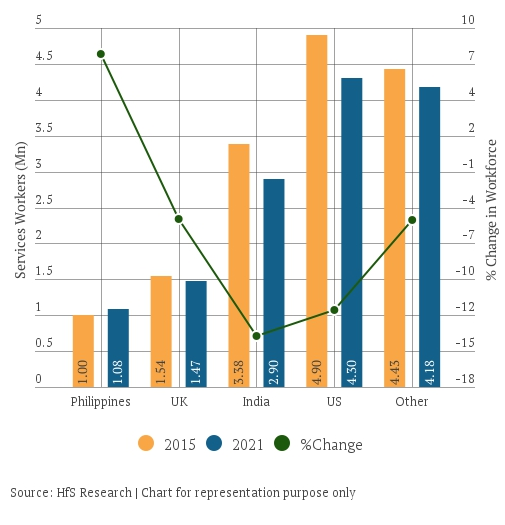
According to a study by Horses for Sources, India is likely to lose 640,000 jobs to IT automation by 2021.
Automation
Unfortunately, for the USD 155 billion industry, the imperative to structurally reorient the business has come at a time when they are facing headwinds like the ones from President Trump's protectionist agenda.The IT service industry employs around 4 million people. A large majority are engaged in jobs that are likely to be non-existent in the future. The old-fashioned manual coding jobs are likely to be replaced by automatic coding and cloud computing that significantly reduces the size of the workforce.
Slow revenue growth and adoption of newer technologies — cloud computing and automation platforms — have started replacing engineers. Hiring will definitely be slower than revenue growth as IT companies try to make their existing employees more productive. The slow pace will affect the middle management as well lower rung of employees doing work that can be automated.
Easy Way Out
The IT industry's success story is not a straight line. The Y2K provided a great opportunity for it to penetrate global corporations while expanding its revenue base. The dot com bubble perpetuated by the internet companies impacted its growth but lasted only for short period of time. In the meantime, US went through a couple of recessions with the 2008 financial crisis being the biggest. The industry also overcame several technological shifts by quickly adopting new technologies and retraining its work force. The Indian IT industry used every crisis as an opportunity to re-invent and re-establish itself as a formidable player in the global software space. Today, it is a mighty, dominant force in the global outsourcing industry with more than 60% market share.The industry is facing several headwinds today, of which some are structural. The whole world is going digital at a rapid pace. Newer technologies like cloud, mobility, Artificial Intelligence, Virtual Reality, etc., are redefining how global corporates consume and spend on technologies. While the global corporations still spend a substantial amount of money on legacy software, the incremental shift in spending on new technologies is humongous. This is a structural change and the industry needs to take several steps, both internal and external, to be relevant in the new digital era.
Chart : Companies with most H1b approval in 2016
Chart : Share of H1b for Outsourcing companies
The new numbers from the agency show that these companies that outsource IT roles do make up a large portion of the H-1B visas issued, according to analysis by Quartz.
H1b numbers for last 10 years show that the companies have gotten used to easy way out and stopped innovation/workflow research. Some companies are using the Global Delivery Model to add bureaucratic controls on a growth oriented industry, at the same time trying to corner the easy visa spots such as H1b for their employees at a steep discount in the open market. Numbers show that the companies have gotten used to cornering the giant share of the H1b visas for cheap labour only without concern for the research and development in this Technology oriented field and have repeatedly lost out on new technology solutions/initiatives to innovative companies from Far east and Europe. The enthusiasm to spend on newer solutions is utterly lacking in many of these offshore companies while they overenthusiastic to manage the operations in relatively well developed markets such as USA, Europe and Middle East.
Chart : Innovation benchmark not maintained by these companies
Chart : Companies with most H1b approval in 2016
Corporate Initiative and CSR
In 2008, Bill Gates spoke at the World Economic Forum about “creative capitalism.” He encouraged companies to identify their expertise- be it technology, agriculture, healthcare- and develop products that could “stretch the market forces.” A slightly more nuanced take on “doing good,” it meant honing in on the business’ specialty, not just throwing money at various charities. He has substantially invested in poorer countries in Africa, Asia and America and demonstrated effectiveness of technology in solving social and subsistence problems of the people.However offshore companies don't do anything like that. Some of the companies such as Wipro and Infosys have announced investment in foundations and also claim to partake in philanthropic activities aimed at poverty reduction. We have in the Satyam saga how the owner tried to claim philanthropic activity in rural health care while trying to gain a share in corporate healthcare while paying only peanuts for the ambulatory services. These companies seem to heed no advice and drift in the direction of self destruction without taking any note of the leadership provided by the technology leaders such as Bill Gates. Taking out huge amount of money from H1b visas without proper direction will stall IT growth and it might take decades to correct the mistakes. This is creating a serious, significant issue for governments of India with a heavy reliance on its workers providing outsourcing services for Western enterprises. None of the companies are addressing the situation here nor they are doing any thing to develop new age technology leaders that can steer the companies to higher grounds. These companies are not investing on soft skills such as Humanities, Reskilling, Basic Sciences and most of the time are relying on government dole in those areas.
Class problems
The upper middle class urban elite that control the management in majority of these IT firms are mostly interested in skimming money using cheap labour on H1b and B1 visa, while they want to make use every dole provided by the government in Humanities development, Basic science development, poverty elimination in lower classes etc... These management people have proved to be real corporate chameleons by being on the top of the job market and have successfully jumped between MNCs and Offshore companies with ease. At the same time the lower middle class dominated programmers and analyst have lost jobs in thousands due to lack of proper leadership in IT field. In long run this will create major class problems if not addressed now. Over the decades these executives have bested the art of creating cheap pyramid schemes and clever head hunting tactics with utter disregard for overall social vision of the programming community. Many of these IT executives have a scant regard for the rules of the country and most of the time tried to aggressively play the international game in politically volatile countries such as Latin america, Africa and Middle east. Once the IT hayride is over these tactics will start coming back to the original perpetrators in future. These issues might provide a big headache to the IT governance at the government level in near future.

These people are further dividing the line between haves and have-not and are also not acknowledging the government schemes that contributed to their development initially. The burden on governments in developing coherent strategy will be immense in coming years to address the ever increase skew in income categories when compared to the rest of the world.
References
- The silent crisis: Why Indian IT engineers are staring at a future of no jobs, Madhuchanda Dey Moneycontrol Research
- Artificial Intelligence and the Death of Indian IT Sector, Harpreet Singh
Tuesday, June 13, 2017
Consumerism and Frauds in IT field
Consumerism and Frauds in the IT field
Introduction
During the
initial years of Westernization of Indians, many intellectuals saw the world as
an undivided humanity that knows no barrier or religion, race, class, and
nationality (Datta, 2003) . Enduring many
invasions through ages, the Indian had a broad and inclusive concept of world
that emphasized amongst so many religions what we had was one among many religion.
Rabindranath Tagore, the Nobel Laureate in Literature from Bengal, captured
this essential oneness of mankind and visualized a universal man in Indian
philosophy in his famous Nobel-winning Gitanjali:
"When
one knows thee, then alien there in none,
Then
no door is shut. Oh, grant me my prayer that
I
may never lose the bliss of the touch of the one
In
the play of the many."
Neo-liberal Mafia
Off late due
to increased westernization from 80's, many religious gurus are professing faith
in neo-liberalism that includes market fundamentalism, consumerism, welfare retrenchment,
and liberal governance, away from Gandhi's idea of Hindu economics. These revivalist
gurus are professing a mix of economic efficiency, ambitious individualism
beyond the traditional Hindu society, selfish narcissism, acquisitiveness and
excessive materialism for their followers that are taking over the traditional
Hindu ethos of toleration and equilibrium in public life. This new culture is
feeding the consumer culture and exploiting the traditional Hindu ethos for the
sake of new technocratic global-consumer middle class concentrated in few
cities.
The Indian
people had firsthand experience of this new naked commercialization where huge
amounts of money was lost in the bubble busts after bull runs aided by mass hysteria
without taking the operating P/E of the sectors into consideration. The new
consumer class that is getting huge flows of capital from West, when examined
closely, appear both self-centered and riven by paradoxes, seeking validation
for their lives from Hindu evangelist gurus even as they acquire the latest
consumer gadgets. At the same time this group hasn't taken the mantle of
leadership in religion-socio-economic development, and when compared to similar
groups in China or Japan or Korea, they have a reputation for creating chaos and confusion. (Deb)
This
dichotomy in daily ethos among these new adherents of the urban revivalist agenda
has created vast number of problems for an average Indian. The neo-liberal
professors of this movement such as Subramanya Swamy have paid a nominal lip
service to the vast population groups in the country while vocally professing their
god given rights for the unbridled consumerism that has sees no responsibility.
Some of these new jingoist adherents have identified a caste-superiority based
logic in placid Hindu society that legitimizes their dominant position in
High-Technology directorships, in Corporate world, in Faculty positions and in
Government positions . Researchers have found that the vast masses at the base
of the Indian economic pyramid are also affected by the spread of consumer
culture. “Increasing desires to consume branded goods that are advertised
through television is …a consistent and recurring theme.” Moreover,
“intertwined cultural processes of conspicuous consumption, normative change [imposing
a link between consumer goods and morality], and [interpersonal] competition” mark
narratives of low caste Indian consumers. They reflect an increasingly
consumerist content of Indian media that depicts the mythic lifestyles of the
rich and famous. (Belk, 2008)
Satyam Scam
For
example, during the High technology growth of Hyderabad in 2000's, this new
revivalist mafia tried to hijack the technology growth for their own selfish
purpose while locking the vast sections of the population in their flawed
pyramid of the new-liberal agenda. The case of Satyam computers highlight the
nefarious potential of loose-canons that would burst the high-technology growth
(only among Indians). The fraud committed by the founders of Satyam is a
testament to the fact that “the science of conduct” is swayed in large by neo-liberal
agenda, ambition/greed, and hunger for power, money, fame and glory. Satyam
fraud spurred the government of India to tighten CG norms to prevent recurrence
of similar frauds in the near future. The government took prompt actions to
protect the interest of the investors and safeguard the credibility of India
and the nation’s image across the world. If the government didn't take action
in time the scandal had the potential to spiral into mass hysteria that would
have jeopardized the entire IT sector that employed 2.5 million people around
that 2009.
Satyam fraud details
From being
India’s IT “crown jewel” and the country’s “fourth largest” company with
high-profile customers, the outsourcing firm Satyam Computers has become embroiled
in the nation’s biggest corporate scam in living memory (Bhasin, 2009)
Satyam
ownership model was flawed from the perspective of good corporate governance.
There may be three factors responsible for this. The factors are not the causes
of global and colossal fraud, but they provide an enabling environment for
abuse and delusion.
1. First,
being a publicly owned company, Satyam could raise capital inexpensively if its
existing shareholders assigned it a high value. Hence, in order to attract
capital from public, it was under pressure to overstate profits to keep the
company’s bonds and equities in high esteem. The promoters formed informal
partnerships with this neo-liberal mafia all over the world targeting the Hindu
temples, Christian and Muslim groups to develop a profitable relationship in
the High-Technology sector based on false promises.
2. Second, the promoter of the company, Mr. B.
Ramalinga Raju, owned a very small fraction of the ownership stock. He diluted
his holding from 25.6 % in 2001 to 3.6 % in 2009. He could overstate profits
with the objective of influencing other shareholders. This ensured that the
whole operation was risk free for the Owners in case of volatility in the IT
sector.
3. Third
important factor for flawed ownership model may be, Satyam could preserve its
fictitious profits without having to pay big taxes because its profits were
protected significantly from the normal tax laws. They do not pay taxes on
fictitious revenues and 22 profits. There are no penalties. The belief that
exempting firms such as Satyam from service tax and corporate income tax will
make them competitive is a little ridiculous. Satyam would not have overstated
its revenues and profits if it had to back both with real cash. A big part of
the blame for the colossal fraud thus belongs to India’s trade and fiscal
policy makers who gave an uneven advantage to the neo-liberal technology mafia
while ignoring the basic fundamentals of the High technology and its impact on
the vast reaches of the population.
The
owners maintained a consumer relation with the neo-liberal mafia over the
period of 2 decades and won numerous corporate awards all recommended by this
mafia. In 2007, Ernst & Young awarded Mr. Raju with the ‘Entrepreneur of
the Year’ award. On April 14, 2008, Satyam won awards from MZ Consult’s for being
a ‘leader in India in CG and accountability’. In September 2008, the World
Council for Corporate Governance awarded Satyam with the ‘Global Peacock Award’
for global excellence in corporate accountability”. The company provided vast
sums of money to this neo-liberal mafia by funding many higher education institutes
such as IIIT, CCMB etc... thereby ensuring and addicting to consumerism the
placid Hindu masses.
The
promoters successfully cashed out of the company in an immoral relationship
with the neo-liberal mafia over the period of 10 years. The cashed money was
used in funding the real-estate companies and the socio-educational entities
that would support this neo-liberal agenda and in future lay the foundations of
the political takeover of the State governments. The owners were successful in creating a huge network of bogus companies that catered to this neo-liberals while systematically subjugating the vast populations to the consumerism. The owners of Satyam in an unethical relationship with this neo-liberal mafia wrongfully tried to influence fiscal and monetary policy of the Southern States by systematically taking over the social, agricultural, financial, educational, governmental, and meteorological aspects of the morbid agrarian population using an aggressive socio-economic agenda that created a new ecosystem of these fraud companies. The idea was to take over the top positions in the corporate, financial, judicial, religious and political ecosphere of this new ecosystem.
The
government acted swiftly by arresting numerous managers for Income Tax evasion
and the directors on numerous criminal charges. However the promoters of Satyam were able to show accounting fraud and go to prison while the neo-liberal mafia behind the company is free.
Requirement for newer controls
However
this episode highlights the lack of controls at the government level on
managing the IT growth and the neo-liberal mafia. The neo-liberal mafia was
successful in promoting Mr. Raju as the poster boy of IT revolution and got an
international audience with likes of Bill Gates, Bill Clinton, Hillary Clinton
etc.. and subsequently benefited in the western countries such as United States
and Canada by monopolizing many jobs in number of sectors.
The limits and responsibilities of operating a IT company catering to rich western clients were not defined properly in the existing company law. This is high-time the bureaucrats open their eye to this new pyramid scheme wrecking havoc on the age-old society in India. There should be harsher criminal punishments for people caught manipulating socio-political-economic environment for selfish greed.
Works Cited
Belk, V. a. (2008). Weaving a web: subaltern
consumers, rising consumer culture, and television. Sage.
Bhasin, M. L. (2009). Creative
Accounting Practices at Satyam Computers. Creative Commons Attribution 4.0
.
Datta, S. (2003). W
(h) ither Indian Mind . IJT.
Deb, S. The Nation
Labels:
Company Act,
Computer,
Corporate,
Court,
Criminal,
Fraud,
Greed,
Hindu,
IT,
Manipulation,
PWC,
Raju,
Ramalinga,
Satyam,
SEBI,
SEC,
Technology
Location:
United States
Sunday, June 4, 2017
Disruption of the traditional offshore business
Coming of RPA and the newer technologies
A recent KPMG report argues that the rising cost of labor is causing BPO to become an non-viable option and that technologies, such as RPA, AI, and other cognitive and automation platforms, are advancing to create more sustainable options. According to this report, more and more companies are turning to "machines with rapidly advancing capabilities for understanding, learning, communicating, and problem-solving. Robotic process automation (RPA)—this convergence of low-cost, easy-to-implement process automation, coupled with machine learning, data analytics, and cognitive innovations—is creating a new class of digital labor." The same report suggests this trend will cause companies to turn to more advanced machines rather than relying on BPOs for the work they need to complete, thus eventually eliminating the need for human workers and BPOs.
Recently, great numbers of business process outsourcers have turned to robotic software to automate back office processes, such as FAO, HR management, and procurement - processes that normally require a human employee to accomplish. It has been estimated that one half to 70% of the work done by shared service, captive, or outsourced operations can be automated using robotic software. This technology not only drastically reduces the cost of labor for business process outsourcers, but it produces better quality work and allows employees to focus on tasks that are much more meaningful. Here are some hard facts that suggest a decrease in the use of BPO is possible. Although it is still a hotspot for outsourcing, India is experiencing a decline in outsourcing. Between 2011 and 2014, the number of deals worldwide declined by 61% and value of these deals shrunk from $206.8 billion to $120.4 billion.
Ever since Trump’s inaugural speech emphasizing an America-first message future for outsourcing is uncertain in America, where global labor markets are being disrupted by various flavors of travel bans to the United States, the specter of a wall being built at the US-Mexico border that costs more than the entire Space-X program, a reform of H1B visas that could likely dismantle the traditional outsourcing model, and a curious thing called Brexit that could change the global trade landscape forever, one might be forgiven for feeling slightly disoriented.
But here are three scenarios that I am seeing for 2017: [Phil Fersht, 2017]
RPA will remain undefined. Over the next 12 months, the perception of RPA will remain blurred. RPA capabilities will fold into broad propositions such as Digital Workforces or Cognitive Automation. This is adding to the continuing confusion around RDA. Extending on that, in 18 months we won’t talk about RPA anymore. Most of the leading technology providers will have been acquired and RPA is a reality in the back-office.
M&A through ISVs. Buyers will have to do scenario planning for acquisitions. While this might bring broader capabilities, licensing costs are likely to increase as well. Pega’s acquisition of OpenSpan is the template for such developments. Beyond the tool providers, the automation pure plays such as Symphony and GenFour are likely to be equally absorbed by larger consultancies.
The emergence of an Automation Ecosystem: We already have seen the impact of Watson, as it is starting to evolve into an ecosystem. Suffice it to say, IBM could be the driving force to extend those capabilities, as we have argued some time ago. But it could equally be one of the tool providers significantly expanding its reach. As stated, we are seeing the providers in the Winner’s Circle moving toward the notion of orchestrating much broader automation capabilities. At the same time, we are seeing providers like Blue Prism and UiPath being deployed in IT-centric scenarios such as IT Help Desk and Application Management, pointing to a convergence of scenarios and tool sets.
Cloud based Business Process
Outsourcing providers have long employed automation. But a recent report from management consulting firm A.T. Kearney highlights the growth in business process as a service (BPaaS), which lets companies hand off routine chores via the cloud to software systems that perform those chores without human intervention. Any activity that is repeatable and rules-based is a good candidate for such automation, said Cliff Justice, a partner for innovation and enterprise solutions at KPMG. "Payroll, AP, order entry—all of those activities follow a set of rules and parameters and workflows." Johan Gott, a principal in the private equity practice at A.T. Kearney, said that while technology enables BPaaS, it is at heart a new business model. "Even though it’s not core technology, it’s the more disruptive trend that we’re seeing," he said. Spending on BPaaS, in fact, is expected to reach $13.7 billion in 2016, up from $12.95 billion in 2015 (Gartner, Forecast Analysis: Public Cloud Services, Worldwide, 1Q16 Update, May 2016).
While automating processes would involve considerable effort and IT resources for an individual company, achieving automation by using BPaaS via the cloud is a much simpler and less expensive option."BPaaS can unlock an enormous potential for growth in BPO services by dramatically expanding the customer pool to smaller and midsized customers," according to the A.T. Kearney report. "The standardized offerings of BPaaS are particularly well suited to smaller companies, which have neither the volume to enter into large contracts, nor the need to outsource more than a few relatively simple processes."
Disruption of BPO
The election of Mr Trump to the Oval pretty much just hammered in the final nail in the coffin for the traditional IT outsourcing market as we know it. The Republicans control the House, the Senate and Trump has a huge mandate to impose his will, not dissimilar from Obama and his healthcare reforms. Change is going to happen and it will likely have a very significant impact on global IT and BPO service delivery. The bad news for the offshore industry is that Trump's protectionist policies are going to accelerate reality and actions will be direct in the form of raising the H1B minimum salary to $100,000 per year, encouraging cloud-based standardized service providers,and intelligent automation of the existing business process. [Phil Fersht, 2017] The attacks are reverberating at companies with production and IT operations in countries like India, China and the Philippines, outsourcing executives say. Some companies are looking for U.S.-based alternatives, while vendors that provide outsourced services are pushing automation as a cost-effective way to re-shore work—but not necessarily jobs.
The Offshore industry has been living with single-digit revenue growth for some time now and is unable to kick-start growth in a big way amid the global macroeconomic and political uncertainties. These companies in India especially are already feeling the pinch financially, and are making blatant attempt to appease the Trump administration by announcing local hiring in USA in a big way. Infosys said following the release of its March quarter results that it would hire about 10,000 people in the U.S. over the next two years. The company plans to open four innovation center hubs in the U.S. Even as this announcement from Infosys created a furor over its potential implication for jobs in India, Cognizant said recently it will rationalize its cost structure by bringing the employee base in line with demand. The company said on the earnings call it intends to ramp up hiring in the U.S., while at the same time reduce dependence on the H-1B visas. For the top offshore companies, there was a steep drop in H-1B visas filing for the year 2017.
Indian IT outsourcing firms are also exploring other options, including setting up near-shore centers or facilities closer to the U.S, with Mexico being the most-sought-after center. Apart from the option helping to face the challenges of a protectionists environment in the U.S., the cost of doing business also comes down by roughly 50 percent. Nasscom says that India's IT industry contributes to over $2 billion in annual taxes in the US, with a cumulative of $20 billion over 10 years, while generating 4,11,000 jobs in the US as in 2015. The industry says that US companies benefit from outsourcing as they can allocate resources to critical work locally."Indian IT sector must now brace for further troubled times ahead. The sector was already battling both cyclical challenges (due to changes and shifts in financial services, healthcare verticals) as well as secular challenges (i.e., cloud shift, automation, pricing pressure, insourcing) impacting revenue growth. A sub 10% growth for FY17 is certain," Arup Roy, Research Director, Gartner said in a statement on November 9.
However the companies that don't diversify their portfolios away from pure body-shopping and process competencies to a technology-driven advantages and that have a big bunch of complacent employees are going to face music in near term from the disruptive wave of automation. While many Asian countries are gearing up to this challenge, the IT sector in India is facing existential crisis largely of its own making because it became complacent and overconfident even as technologies and markets changed.
References
- On the Eve of Disruption, https://www.atkearney.com/documents/10192/7094247/On+the+Eve+of+Disruption.pdf/49fa89fa-7677-4ab8-8854-5003af40fc8e, A.T. Kearney, 2016
- RPA and BPO minor changes or real disruption, https://www.uipath.com/blog/rpa-and-bpo-minor-changes-or-real-disruption, UIPATH, 2016
- RPA 2017 report, http://www.horsesforsources.com/RPA-provider-blueprint-snapshot_022217, Phil Fersht, 2017
Subscribe to:
Comments (Atom)
Major migrations in India
Major migrations in India "MAJOR MIGRATIONS IN INDIA" Toba eruption 75k years back restricted spread of humans and caused brief ...