In June quarter 2019, the combined top line of the top five IT services companies -- TCS, Infosys, HCL, Wipro and Tech Mahindra -- stood at Rs 99,800 crore, just Rs 200 crore shy of the Rs 1 lakh crore mark. These companies have hired more than 1M+ people recently. The top companies TCS & Infosys have combined destroyed multiple state ecosystems while creating highly paid zero R&D & zero applied solutions to the IT market. Most of their work has been focused on writing custom solutions that are specified by their clients, which in most cases are big institutional MNCs or National firms that were assigned by their govt to give work to these body shoppers.
TCS has destroyed the R&D infrastructure of Tata companies in Automobile & Iron/Steel by placing govt educated (IIT, NIT, govt engg, Central Univs) post graduates meant for these long term positions into quick money producing body shopper low level Programmer/Tester/Analyst positions all over the world while taking a huge cut of salary for their fake management consisting of few privileged sub-caste members. These directors have demonstrated their fraud capacity by forming profit cartels in collision with vocal minority groups/movements in US and also have formed world wide profit cartels to skim the money out of system.
Likewise, Infosys has formed multiple fake delivery centers in US & research institutes to maintain a highly paid group of managers who are mostly linked to the management as nepotism. These delivery centers are mostly local political stunt to create image of big company among the newly hired junior Programmer/Analysts to work 24/7 using Software downloaded from Internet while the management using most advanced financial methods to skim the system and move the money out to few sub-caste cartels that are spread out in urban ghettos world wide.
In addition these top IT body shoppers are skimming the system by giving back lakhs of Crores of money to their holders in the form of stock buyback. This is like highway robbery of public money given in the form of contracts making their way to the private profit oriented investors. Even though they have huge cash in hand, the R&D efforts of these companies don't go beyond few related directors kin getting into elite western arts universities all within few sub-caste living in their fantasy urban ghettos. In addition these kin have created huge ecosystem at the management level in US & Europe eg. Sundar Pichai etc.. getting 100s of crores per year as salary for just attending board meetings and signing papers.
These highly entitled top managers formed a cartel and exploiting poor people of their sub-castes to make work unnecessary hours to sustain their network. End level employees died by hundreds due to work burnout and social pressures caused by these fraudulent managers playing with government money
Bibilography
https://www.deccanherald.com/business/economy-business/indias-top-5-it-firms-stare-at-historic-revenue-mark-766973.html
https://timesofindia.indiatimes.com/business/india-business/tcs-to-spend-rs-16000-crore-on-share-buyback/articleshow/64608787.cms
Showing posts with label consumerism. Show all posts
Saturday, October 12, 2019
Wednesday, December 6, 2017
Consumerism and decline of the Throw-away Society
We’ve got kind of a problem here. On the right side of the pendulum, consumerism has reached an all-time high, with products reaching their planned obsolescence within absurdly short time-spans and new products being rolled out (and bought) by the millions every day. And, since every action has an equal and opposite reaction , we have to expect consequences. So, on the left side of the pendulum, we’re looking at the very real possibility of a mass extinction, the sixth on record for our planet and the first since the extinction of the dinosaurs – sixty five million years ago.
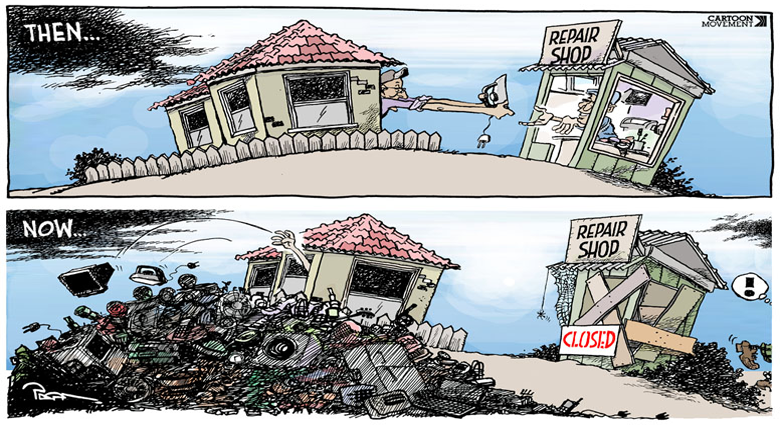
We live in a throwaway society. Innovation in the tech industries mean ever more powerful products come to market. But the death of repair shops and a culture of reliance is not simply the result of shiny new things. Corporations, and capitalism itself, requires planned obsolesce. It’s tempting to write off the decline of repair in the West as collateral damage – just another unintended cost of globalization – but the evidence suggests that it’s actually an intended consequence. To see why, it’s helpful to look at the particular needs of capital in the global growth economy – needs that led to the creation of the consumer culture just over a century ago.
However it is not so rosy in these developing countries, where expectation is that there is no collateral damage, in actuality the rot is widespread in these new generation of so called service-oriented companies professing western liberalization on the economy. The real reason is that the modern consumer culture was born – not as a response to innate human greed or customer demand, but to the needs of industrial capital. These new mega service oriented corporations are catering to even bigger corporations in the west in a pure crass consumerism culture. There is no genuine culture of reliance or of local human development in these new-age mega corporations which cater exclusively to who ever spends on them and ignore their environment including their own buildup human capital.
The consumption of household goods in Western society is now at its upper limit, so much so that Steve Howard, Ikea’s head of sustainability, said it had reached “peak stuff”. While he was quick to say that this did not contradict Ikea’s target to double sales by 2020, he suggested a break from a prevailing “take, make, use, throw” economic model towards a circular model that encourages repair, reuse and collaborative ventures that share the use of products. In reality obsolescence has been a particularly powerful force in the high-tech world, where the limited lifespan of digital devices is more often the result of 'innovation' than malfunction. This is forcing the new-age mega high-tech to rely on this artificial innovation rather their pure technological or customer excellence. Who ever has stronger authority or requirement to stay in this new-age supply chain is being continued by the capitalism until they find next big consumer who can continue the innovation life-cycle. This attitude has destroyed the corporate culture of the developing nations considerably by introducing the back-door consumerism in everyday people life.
There are, obviously, a boatload of reasons why society has evolved into such a remarkable waste producing machine. Whether its food, housing, energy or consumer products, we are taking more from the planet than we ever have before, and there’s more of us doing it. Most of us eat more, use more, buy more and have more than we need. And we throw more of it in the garbage. A lot more.
Take, for example, this scenario. In 1977, the average annual income per capita (US) was $5,785.00 ($20,256.00 2013 CPI-U-RS adjusted dollars). In 2013, the average annual income per capita was $28,829.00[3]. The Apple II (one of the first mass produced microcomputers) came out in 1977, and could be purchased for an average of $1950.00[4] (depending on memory) with a base price of $1298.00[5]. That means for the average person to buy the average Apple II computer in 1977, they would need to shell out a whopping 33.7% of their annual income. For the purposes of this scenario, and understanding that this is an oversimplified example for argument sake, I’ll stick with Apple; the average price of a MacBook in 2013 was $1,286.00[6]. So, for the average person to buy the average Apple computer in 2013, they would need to spend just 4% of their annual income. Needless to say, affordability for tech items has increased considerably. This example is just for computers, but think about all of the other equipment we rely on that was once out of reach for the average person. Vehicles, televisions, phones, electronic appliances – in developed nations these things are staples, we all have them – multiples of them even, and we upgrade them at an alarming rate. Drawn in by advertising that boasts leading fuel economy, high efficiency, faster processing speed, better graphics, we buy things we think will improve our quality of life, and often even be better for the environment. In reality there is no requirement for such massive splurge in the electronics, however just because the economy requires this these new-age mega corporations are forcing people to consumerism. This rot apart from consumer's high-tech habits is affecting the long term stability of their families itself.
Pope recently said people today have been stripped of their humanity and turned into cogs of a "social, economic system, a system where inequalities rule." He likened the process to the way Italian "grappa" or brandy is made, in which grapes are distilled and transformed into something completely different. Individuals, he said, are also being run through a sort of "organizational" distillery -- transforming their original essence, making them "lose their humanity" and "become an instrument of the system." He said there is "a politics, a sociology" and a mindset of people being "disposable; you throw away what isn't needed, because man isn't at the center." Low birthrates show that children are considered disposable, as are the elderly, and also an "entire generation of young people, and this is very serious." High unemployment for young adults has created a "neither-nor" generation of young people who "neither study nor work," he said, because -- for so many -- getting a higher education isn't possible and there are no jobs. This is a real downward spiral...
People need to be made the focus again and become "the center of society, of thinking, of reflection," he said, urging the group to study and reflect "so that man is not disposed of." That the human person should be at the center of all things, "isn't theology, it's not philosophy, it's human reality," the pope said.
Unless this rot of throwaway society due to consumerism is tackled by the government watchdogs there is a big possible impact for the Human race as a whole and the reality of the human life. With the raise of robotic economy there is a real danger of humans in third world countries controlled by these mega service-oriented corporations becoming decadent in near future.
References
1. Consumerism, Mass Extinction and our Throw-Away Society, Kristi Gartner, https://www.theartof.com/articles/consumerism-mass-extinction-and-our-throw-away-society
2. Our obsolescent economy: modern capitalism and 'throwaway culture', Steve Gorelick, https://theecologist.org/2017/sep/26/our-obsolescent-economy-modern-capitalism-and-throwaway-culture
We live in a throwaway society. Innovation in the tech industries mean ever more powerful products come to market. But the death of repair shops and a culture of reliance is not simply the result of shiny new things. Corporations, and capitalism itself, requires planned obsolesce. It’s tempting to write off the decline of repair in the West as collateral damage – just another unintended cost of globalization – but the evidence suggests that it’s actually an intended consequence. To see why, it’s helpful to look at the particular needs of capital in the global growth economy – needs that led to the creation of the consumer culture just over a century ago.
Market for neo-capitalists in the growth
However it is not so rosy in these developing countries, where expectation is that there is no collateral damage, in actuality the rot is widespread in these new generation of so called service-oriented companies professing western liberalization on the economy. The real reason is that the modern consumer culture was born – not as a response to innate human greed or customer demand, but to the needs of industrial capital. These new mega service oriented corporations are catering to even bigger corporations in the west in a pure crass consumerism culture. There is no genuine culture of reliance or of local human development in these new-age mega corporations which cater exclusively to who ever spends on them and ignore their environment including their own buildup human capital.
The consumption of household goods in Western society is now at its upper limit, so much so that Steve Howard, Ikea’s head of sustainability, said it had reached “peak stuff”. While he was quick to say that this did not contradict Ikea’s target to double sales by 2020, he suggested a break from a prevailing “take, make, use, throw” economic model towards a circular model that encourages repair, reuse and collaborative ventures that share the use of products. In reality obsolescence has been a particularly powerful force in the high-tech world, where the limited lifespan of digital devices is more often the result of 'innovation' than malfunction. This is forcing the new-age mega high-tech to rely on this artificial innovation rather their pure technological or customer excellence. Who ever has stronger authority or requirement to stay in this new-age supply chain is being continued by the capitalism until they find next big consumer who can continue the innovation life-cycle. This attitude has destroyed the corporate culture of the developing nations considerably by introducing the back-door consumerism in everyday people life.
There are, obviously, a boatload of reasons why society has evolved into such a remarkable waste producing machine. Whether its food, housing, energy or consumer products, we are taking more from the planet than we ever have before, and there’s more of us doing it. Most of us eat more, use more, buy more and have more than we need. And we throw more of it in the garbage. A lot more.
Take, for example, this scenario. In 1977, the average annual income per capita (US) was $5,785.00 ($20,256.00 2013 CPI-U-RS adjusted dollars). In 2013, the average annual income per capita was $28,829.00[3]. The Apple II (one of the first mass produced microcomputers) came out in 1977, and could be purchased for an average of $1950.00[4] (depending on memory) with a base price of $1298.00[5]. That means for the average person to buy the average Apple II computer in 1977, they would need to shell out a whopping 33.7% of their annual income. For the purposes of this scenario, and understanding that this is an oversimplified example for argument sake, I’ll stick with Apple; the average price of a MacBook in 2013 was $1,286.00[6]. So, for the average person to buy the average Apple computer in 2013, they would need to spend just 4% of their annual income. Needless to say, affordability for tech items has increased considerably. This example is just for computers, but think about all of the other equipment we rely on that was once out of reach for the average person. Vehicles, televisions, phones, electronic appliances – in developed nations these things are staples, we all have them – multiples of them even, and we upgrade them at an alarming rate. Drawn in by advertising that boasts leading fuel economy, high efficiency, faster processing speed, better graphics, we buy things we think will improve our quality of life, and often even be better for the environment. In reality there is no requirement for such massive splurge in the electronics, however just because the economy requires this these new-age mega corporations are forcing people to consumerism. This rot apart from consumer's high-tech habits is affecting the long term stability of their families itself.
Pope recently said people today have been stripped of their humanity and turned into cogs of a "social, economic system, a system where inequalities rule." He likened the process to the way Italian "grappa" or brandy is made, in which grapes are distilled and transformed into something completely different. Individuals, he said, are also being run through a sort of "organizational" distillery -- transforming their original essence, making them "lose their humanity" and "become an instrument of the system." He said there is "a politics, a sociology" and a mindset of people being "disposable; you throw away what isn't needed, because man isn't at the center." Low birthrates show that children are considered disposable, as are the elderly, and also an "entire generation of young people, and this is very serious." High unemployment for young adults has created a "neither-nor" generation of young people who "neither study nor work," he said, because -- for so many -- getting a higher education isn't possible and there are no jobs. This is a real downward spiral...
Addicted to Consumerism/Throwaway culture
People need to be made the focus again and become "the center of society, of thinking, of reflection," he said, urging the group to study and reflect "so that man is not disposed of." That the human person should be at the center of all things, "isn't theology, it's not philosophy, it's human reality," the pope said.
Unless this rot of throwaway society due to consumerism is tackled by the government watchdogs there is a big possible impact for the Human race as a whole and the reality of the human life. With the raise of robotic economy there is a real danger of humans in third world countries controlled by these mega service-oriented corporations becoming decadent in near future.
References
1. Consumerism, Mass Extinction and our Throw-Away Society, Kristi Gartner, https://www.theartof.com/articles/consumerism-mass-extinction-and-our-throw-away-society
2. Our obsolescent economy: modern capitalism and 'throwaway culture', Steve Gorelick, https://theecologist.org/2017/sep/26/our-obsolescent-economy-modern-capitalism-and-throwaway-culture
Subscribe to:
Comments (Atom)
Major migrations in India
Major migrations in India "MAJOR MIGRATIONS IN INDIA" Toba eruption 75k years back restricted spread of humans and caused brief ...
-
MyTrueancestry analysis of my ancestry Analysed DNA Y DNA : H-M69 -> H-M82 -> SK1225 -> H-Z5888 -> H-Z5890 -> H-CTS8144 [CT...
-
Major migrations in India "MAJOR MIGRATIONS IN INDIA" Toba eruption 75k years back restricted spread of humans and caused brief ...
-
Overview : Autosomal DNA testing is the method by which you can trace your ancestry by having your autosomes analyzed. A utosomal DNA is ...